
FAB CE News
 The Grant Agreement for FAB CE’s Free Route Airspace from the Black Forest to the Black Sea study was signed on 27 November, 2015. The study is co-financed by Connecting Europe Facility (CEF) with over one million euros of co-financing and will be managed by SESAR Deployment Manager.
The project was selected for funding under the SESAR priority of the 2014 CEF Transport calls, which made 13 billion euros available to finance projects to improve European transport infrastructure, promote transport safety, develop intelligent transport systems and mitigate the environmental impact of the sector. The study contributes to the deployment of Flexible Airspace Management and Free Route, one of the six ATM functionalities identified in the Pilot Common Project (Regulation (EU) No 716/2014).
About the study
The title of the study reflects FAB CE’s determination of creating a concept whose potential does not end where its geographical borders do: it reflects a forward-thinking attitude that benefits not only the Functional Airspace Block, or even one single region, but the added-value will be recognizable on a European scale. The study takes the commitment of the seven FAB CE ANSPs, seven countries with one common goal: the defragmentation of airspace that supports the Single European Sky.
The aim of the technical feasibility study, which was launched in September 2015 and will be completed by April 2017, is to develop and validate the Free Route Airspace Concept of Operations (CONOPS) within the Functional Airspace Block Central Europe (FAB CE) with the potential of extending it beyond its borders. The study will include the development of the CONOPS, simulation exercise (simulations at HungaroControl’s Centre for Research Development and Simulation will be performed as a means of validation) to validate the findings and a detailed elaboration on the necessary ATM system requirements to connect the individual ATM systems.
By 2019, FAB CE aims to fully implement the FRA concept. For the users this will mean that within dedicated Free Route Airspace they may freely plan routes across the whole FAB area, respectively between defined entry points and defined exit points, with the possibility to route via intermediate waypoints. There will be no reference to the Air Traffic Service route network, subject to airspace availability. Within this airspace, flights remain at all times subject to Air Traffic Control and to any overriding airspace restrictions. The main objective of FRA implementation is to offer opportunities for the users to improve the efficiency of plannable direct routes, trajectories both within the FAB CE airspace and between neighbouring FABs.
FAB CE Aviation Services Limited is the affiliated entity of Austro Control, ANS CR, Croatia Control, Hungarocontrol, LPS SR, Slovenia Control and will act as the main decision-making body supporting the implementation of the Action, and its legacy following its completion. in general, it will be responsible for the management of several projects related to the improvement of air navigation efficiency in the region, since the major goal of the establishment of the affiliated entity was to foster the implementation of agreed deliverables of FAB CE projects on the one hand, while on the other hand, the goal was to facilitate the exchange of services and to assist the whole FAB CE Programme, with high-level professional ATM expert support, project management techniques, and professional administrative services.
About Connecting Europe Facility
Regulation (EU) 1316/2013 established Connecting Europe Facility “which determines the conditions, methods and procedures for providing Union financial assistance to trans-European networks in order to support projects of common interest in the sectors of transport, telecommunications and energy infrastructures and to exploit potential synergies between those sectors. It also establishes the breakdown of the resources to be made available under the multi-annual financial framework for the years 2014-2020.”
CEF is a key EU funding instrument to promote growth, jobs and competitiveness through targeted infrastructure investment at European level. It supports the development of high performing, sustainable and efficiently interconnected trans-European networks in the fields of transport, energy and digital services. CEF investments fill the missing links in Europe's energy, transport and digital backbone.
FAB CE Newsletter Winter 2015 (pdf)
In this Issue:
- - Dr Franc Željko Županič, CEOC chair
- - FAB CE strategy aligns with EC targets
- - FCE manages project implementation
- - Free Route Airspace achievements
- - Safety policy unites member states
- - PRB welcomes performance plan
- - TEC Sub-Committee targets costs
- - Sharing common training tools
Inter-FAB cooperation FAB EC, FAB CE, UK-Ireland FAB
47 new plannable direct routes (DCT) have come into operation in continental Europe, covering the northwest-southeast axis between the United Kingdom and Hungary. In February 2016, more DCTs will be added that stretch through the UK to the Eastern borders of Ireland.
The new route options were developed in summer 2015 by experts from Austro Control, HungaroControl, Maastricht UAC and NATS under the auspices of the DFS control centre Karlsruhe . The objective of the initiative is to optimise the central European DCT network along the European main traffic flow in close cooperation with the Network Manager (EUROCONTROL). Today, airspace users can avail themselves of well over 1.000 DCTs in this highly frequented airspace.
Against this backdrop, the main focus of the experts was twofold: optimising the existing DCT network along a main traffic flow stretching across several FABs, including FABEC, the UK-Ireland FAB and FAB CE; and connecting the DCT network in the dense central European airspace with the Hungarian free route airspace offering new flexibile options to the airspace users.
Based on calculations of the Network Manager (EUROCONTROL), these new routes will allow airlines to save up to 785 tonnes of fuel per year. Emissions of CO2 will be reduced in the magnitude of 2,616 tonnes.
Map of DCTs
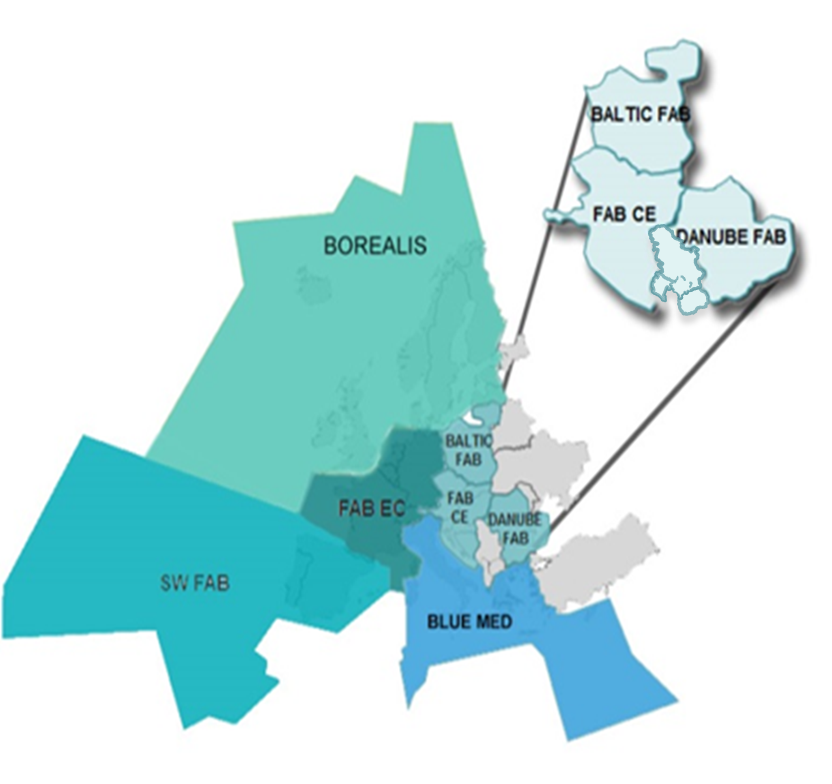 The members of the GATE One (GO) initiative, which is one of the largest regional ANSP platforms in Europe, agreed to play a more active role to explore potential for future inter-FAB cooperation. The CEOs of the GO Initiative which includes designated ANSPs covering 3 existing FABs (Baltic FAB, Danube FAB and FAB CE) and 2 non-EU FIRs (Belgrade and Skopje) - at their meeting in Sofia on 3rd December agreed to strengthen their operational and technical cooperation.
As a pilot common project the CEOs proposed to launch a study to synchronize cross-border Free Route (FRA) implementation in the region for the airspace serviced by GO members. The participating CEOs went along with the opinion to keep GO as a cooperation platform. „The ANSP members supported the proposed vision, which will allow us to work more closely together among others for airspace optimization, thus to be able to offer the best possible longer term ATM solutions for our airspace users” – said Miroslav Bartos, Chairman of the GO CEO Committee meeting. GO members will continue with their ongoing FAB development and national ATM improvement projects. GO FRA shall be developed on top of the existing ATM efforts being a kind of regional FRA umbrella project. It will be built step by step, making best use of the lessons learnt from similar regional initiatives and to get common benefits from SES/SESAR deployment.
Another significant outcome of the meeting was the accession of SMATSA (the Serbian-Montenegro ANSP) and M-NAV (Macedonian ANSP) to the GO initiative. „We are very pleased to join the GO initiative, thus we can act as a bridge between our region and other initiatives. We look forward to working on airspace defragmentation together with all GO members. Our airspace is an important transit corridor and we need to develop a synchronized FRA Concept of Operation in close cooperation with our neighbouring ANSPs. For us, GATE One is also a „door” which can bring us to a future pan-European Single Sky” – stated the SMATSA and the M-NAV delegation.
Note to editors GATE One (GO) is a bottom up regional ANSP initiative established in 2013. The members of GO are ANS Czech Republic, Austro Control, BHANSA, BULATSA, Croatia Control, HungaroControl, LPS Slovak Republic, M-NAV, ORO NAVIGACIJA, PANSA, Romatsa, Slovenia Control and SMATSA. In 2014 GO members provided air navigation services for 3.4 million of IFR flights in 3 FABs. This is about 35% of the total number of European Air Traffic. The GO average cost of ANS provision remained well below the European Key Performance Area (KPA) cost efficiency target.
Social Dialogue Charter amended - ATCO Mobility Paper Signed 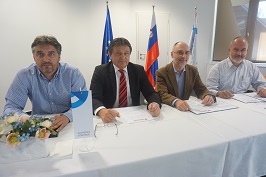
The second FAB CE Social Dialogue Forum was held on November 19 in Ljubljana. Chaired by Franc Željko Županič, CEOC Chairman, and co-chaired by Mr. Željko Oreški (Alpe Adria Alliance), the Forum was attended by over 40 participants, including observers from SMATSA Trade Union. The Forum was conducted in a very positive and constructive manner by all participants.
Two major milestones were achieved at the Social Dialogue Forum in Ljubljana. First the Social Dialogue Charter was amended, paving the way for the FAB CE Alpe Adria Alliance to officially join the Social Dialogue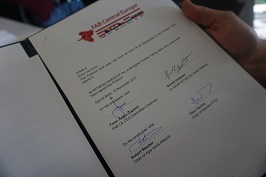 . This represents a significant step in further improving and solidifying the good relationship between ANSPs and unions.
This was followed by the signing of the ATCO Mobility Paper by the CEOC and the ATCO unions. After months of intensive discussions an agreement was finally reached. The paper contains the common position of Air Navigation Services Providers and the ATCO Unions regarding the mobility of ATCOs. Among the principles agreed upon were that ATCO mobility should not be used as a tool to introduce social dumping and that a consultation process should be set up at a national level to avoid conflicts. The positive outcome of this Social Dialogue Forum was a perfect showcase of ANSPs and unions working together to achieve results, which benefit all parties.
Other topics on the agenda included updates on the FAB CE Strategy, the FAB CE Legal Entity, FAB CE Just Culture and the FAB CE Safety Performance Indicators.
ANSP Cooperation Agreement signed by DANUBE FAB and FAB CE aims towards the optimisation of air traffic management (ATM) in the region
An agreement at Air Navigation Services Provider (ANSP) level between DANUBE FAB and FAB Central Europe (FAB CE) was signed on 14 October 2015 by the Co-Chairmen of the DANUBE FAB ANSP Board and the Chairman of the FAB CE CEO Committee, with the aim of establishing and enhancing cooperation in ATM in the two adjacent Functional Airspace Blocks.
The Agreement was signed with the occasion of the Second Inter-FAB Coordination Workshop organised by the DANUBE FAB in Bucharest, where all nine FABs attended with a view to enhance cooperation and share lessons learned.
Through the signature of this Agreement, DANUBE FAB and FAB CE have created a framework for cooperation for nine ANSPs; BULATSA and ROMATSA on the part of DANUBE FAB, and Austro Control, BHANSA, Croatia Control, ANS CR, HungaroControl, LPS SR and Slovenia Control on the part of FAB CE. Establishing a flexible cooperation mechanism, the agreement will contribute towards the safe, efficient and optimised provision of air navigation services.
The Agreement supports the Single European Sky legislation, with the aim of providing a safer, more cost-efficient, environment-friendly and performance-driven service. The areas of cooperation under the Agreement include the areas of operations, technical, training, performance and safety.
DANUBE FAB and FAB CE are committed to continue engaging with neighbouring EU and non-EU States so as to deliver additional benefits and further contribute towards better performance. This signing completes a set of three agreements, between BLUE MED FAB, DANUBE FAB and FAB CE , which collectively form a triangle of cooperation in the region, laying a strong foundation to improve performance throughout South-Eastern and Central Europe.
Page 30 of 42
 FAB CE on LinkedIn